Assemble your business suite. Don't buy someone else's.
One data layer, one identity, one permission model. Only the applications you need.
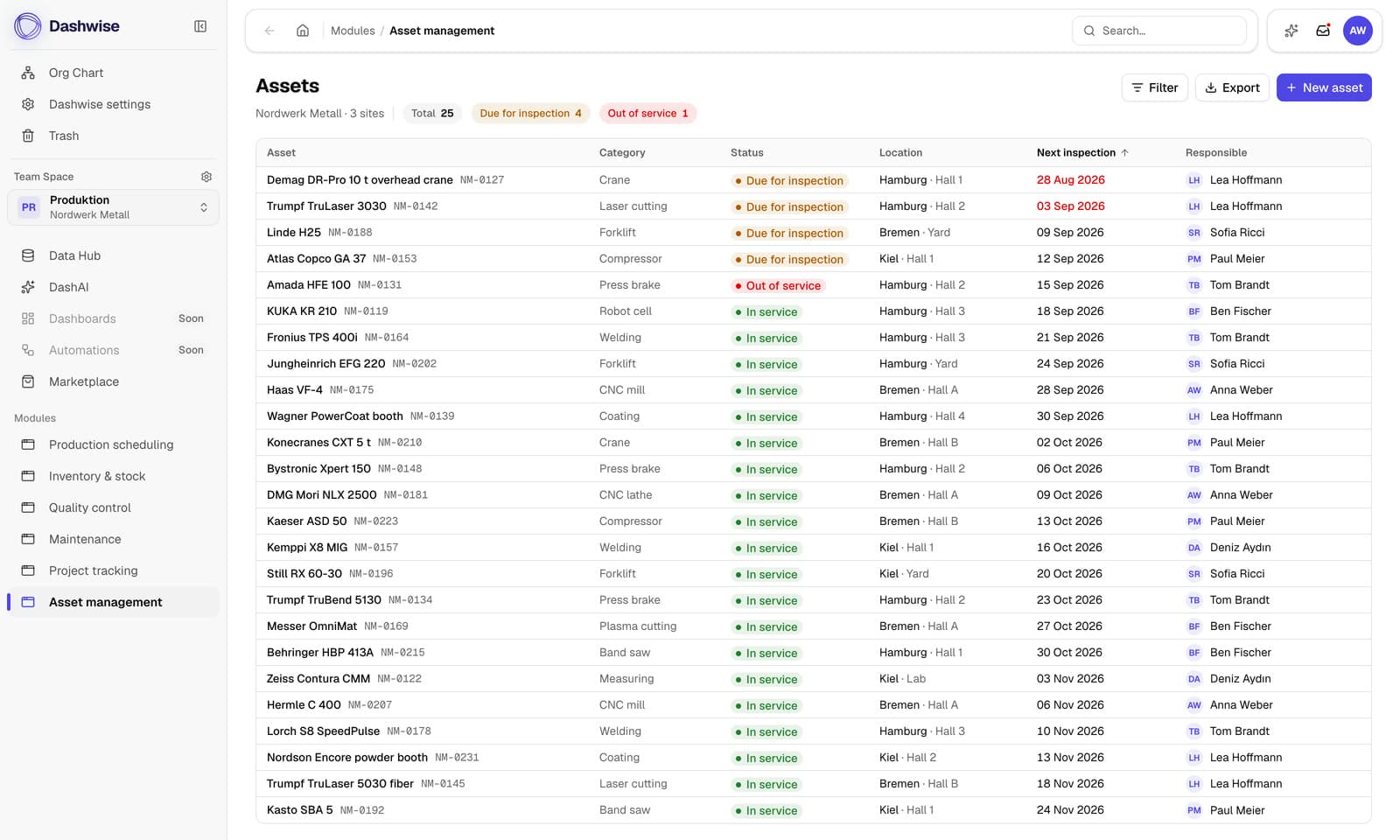
Your choice just got a lot easier.
| Monolithic ERP | Point SaaS tools | Dashwise | |
|---|---|---|---|
| Where data lives | One vendor's schema | Fragmented per tool | One data layer per workspace |
| Changing something | Change request, consultants | Not possible | Install or build a module |
| Replacing one capability | Replace the suite | Another integration | Swap one module |
| Identity and permissions | Single and rigid | Duplicated everywhere | Shared, layered per module |
Explore the four pillars
The Platform
Everything an admin runs from one place.
Six things your workspace brings before you install a single module.
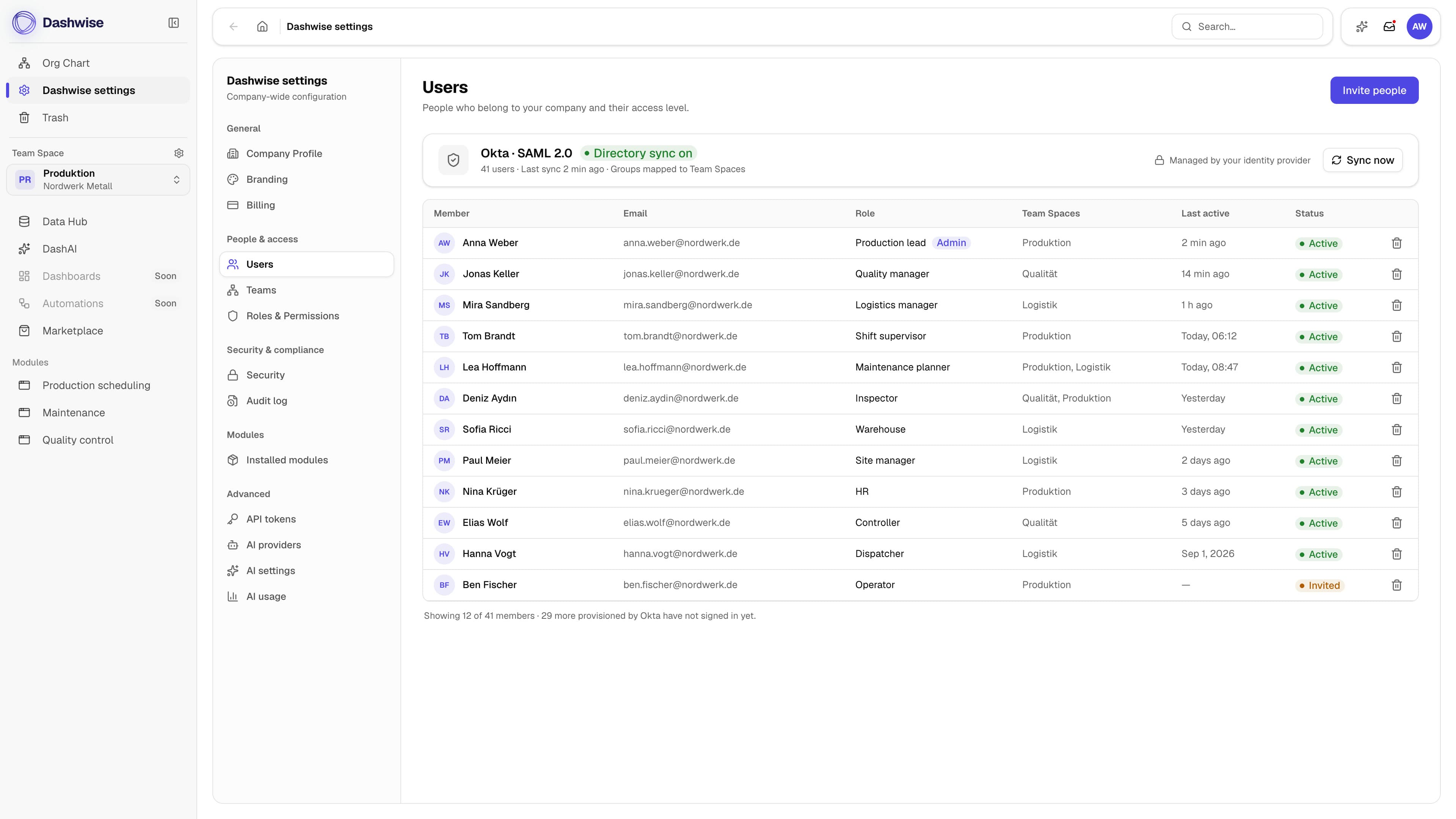
User and team management
Everyone sits in one directory. With SSO and SCIM, joiners and leavers follow your identity provider.
- Invite by email or provision automatically through SCIM
- One profile per person, however many modules they end up using
- Deactivate once, and every module follows
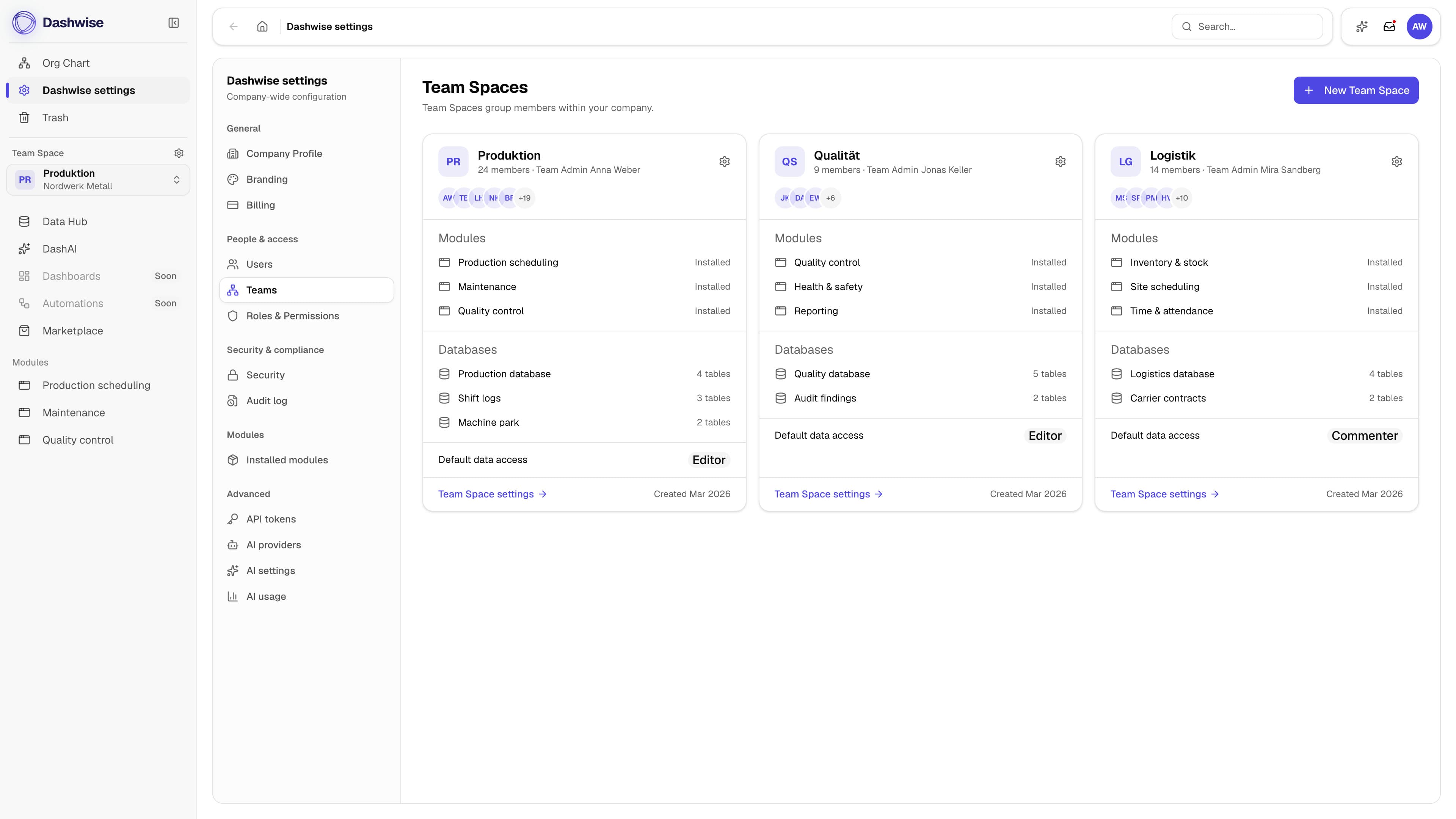
Teamspaces
A teamspace is a department's own corner of the workspace: its people, its modules, its views.
- Own members, own modules, own saved views
- A person sits in as many spaces as their job needs
- Nothing is duplicated, there is one directory underneath
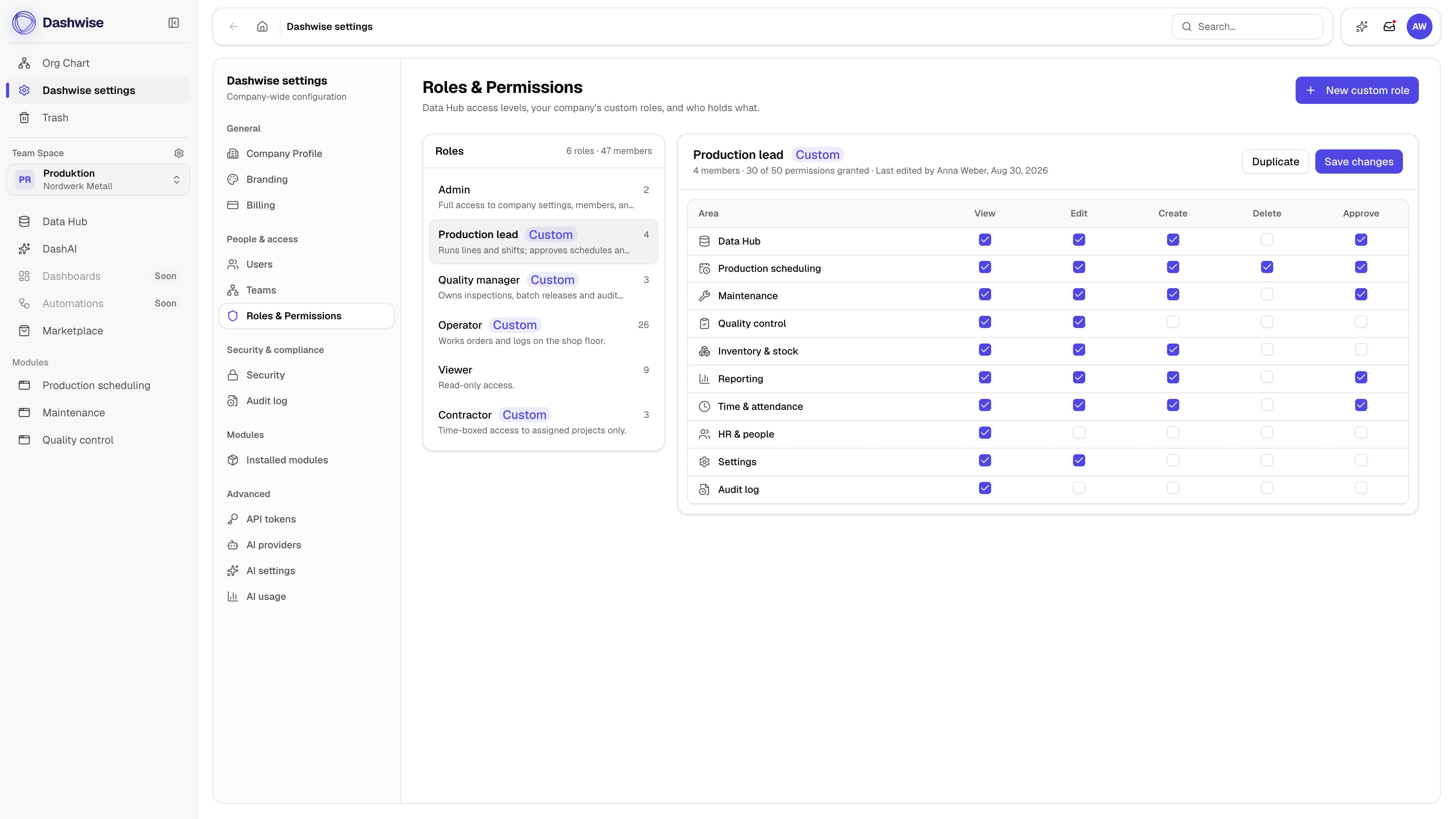
Roles and permissions
Access is decided once, per role. The module, an export and a DashAI answer all ask the same layer.
- Roles at workspace level, refined per module
- View and manage are separate grants, never one switch
- Every change lands in the audit log
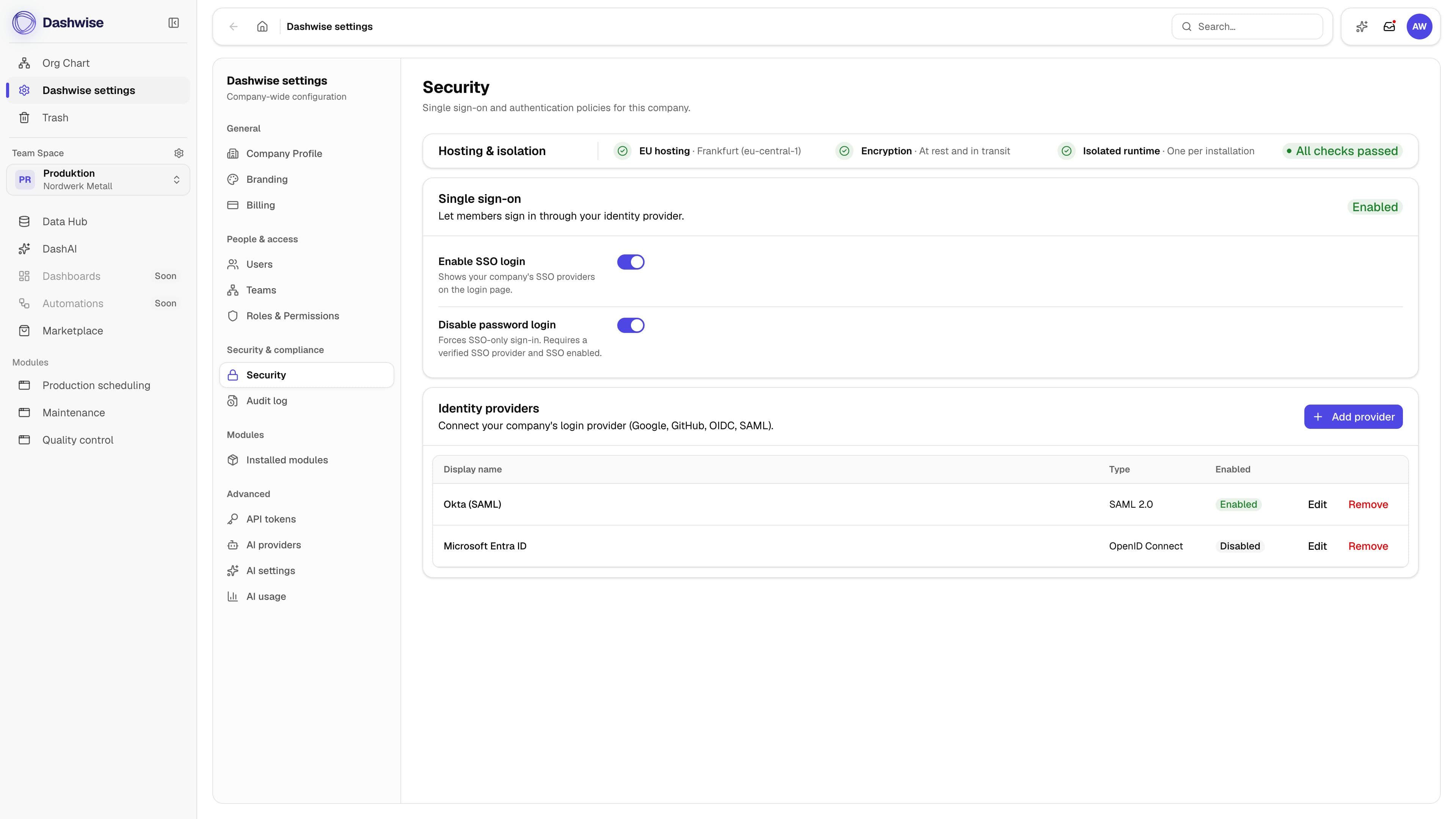
Dashwise Security
EU hosting, encryption, an isolated runtime per installation. Nothing added later opts out.
- EU hosting, encrypted in transit and at rest
- One scoped key per installation, revocable at any time
- Ten years of audit log, across every module
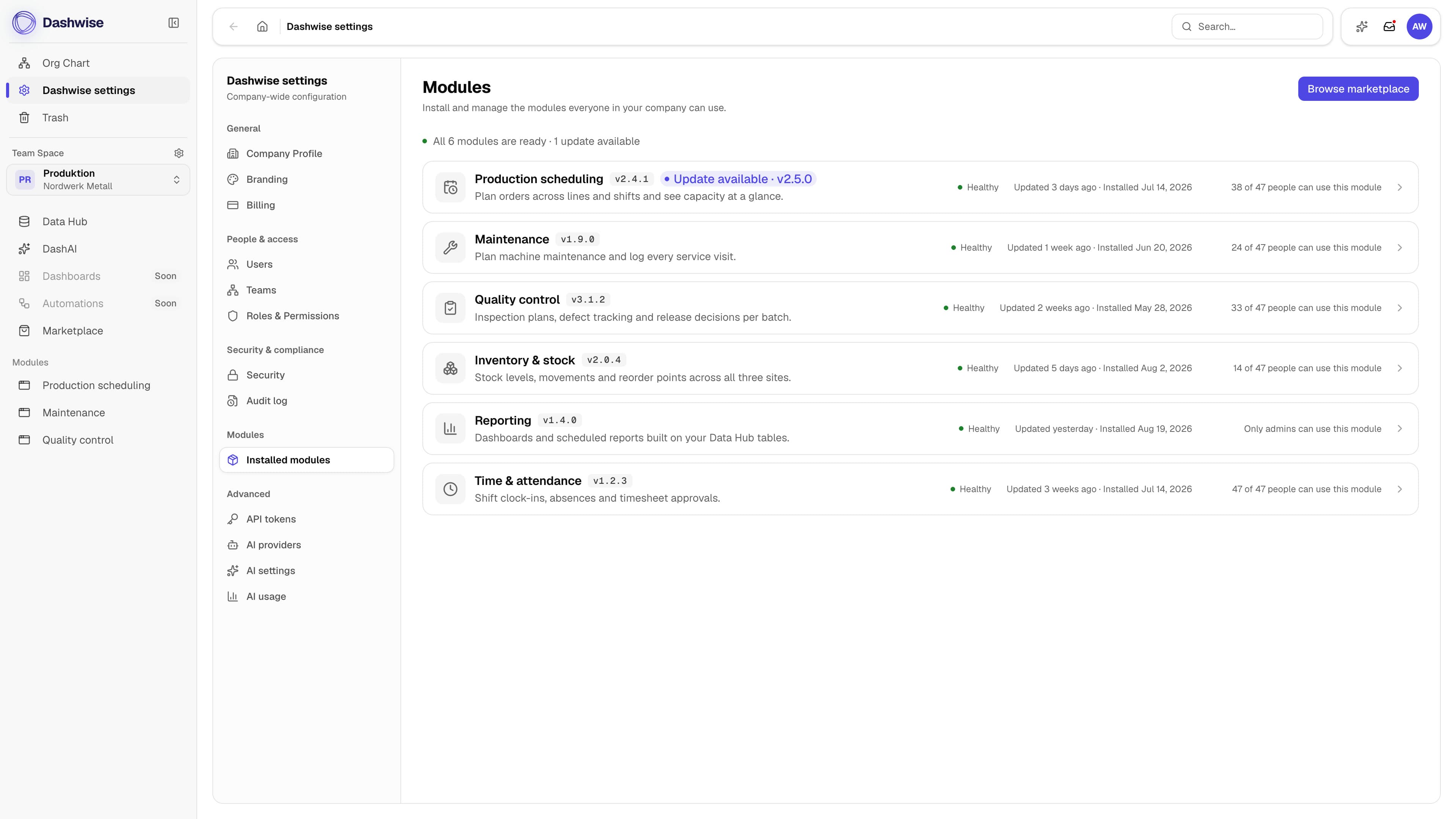
Modular and scalable
Start with one module. The next arrives when the work asks for it, and modules version independently.
- Install, pause or remove a module without touching the rest
- Pricing follows what is switched on, per workspace
- Custom modules run on exactly the same runtime
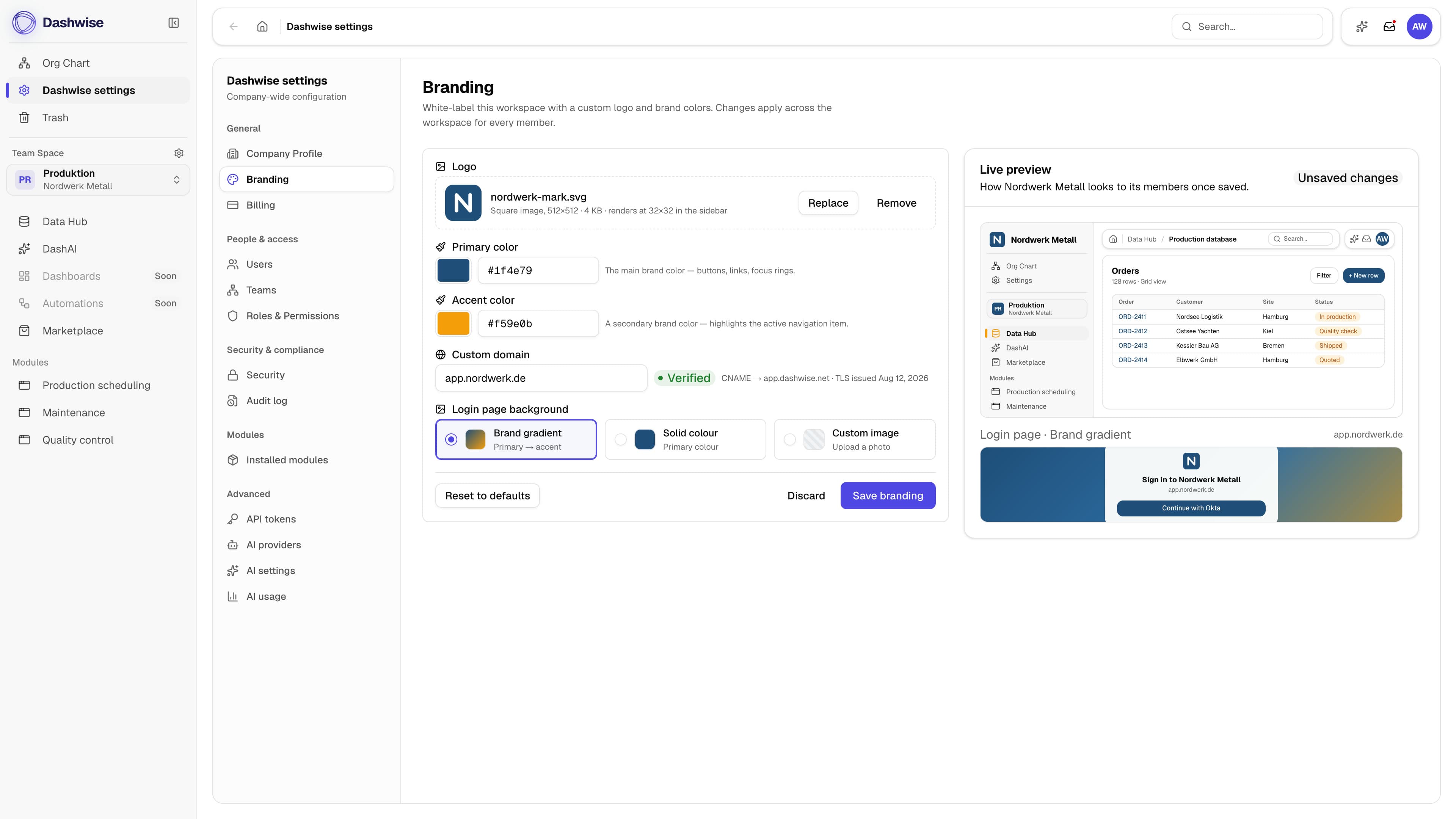
Custom branding and many more settings
Your logo, colors and domain on the workspace your team signs into, next to formats and session rules.
- Logo, palette and a domain of your own
- Language, formats and notifications per workspace
- Admin settings on one screen, not scattered per module
Data Hub
Your operational data, stored as real Postgres tables, not JSON blobs.
You define your data layer yourself: tables, fields, relationships, views. Each one is a real Postgres table you can query directly.
Migrate your data
Import from spreadsheets or existing systems. Types are checked as the rows land.
Govern your data
Access is set once and every table inherits it. Reads and writes land in the audit log.
Operate your data
Modules read and write through declared bindings. Metabase or Power BI read the same source.
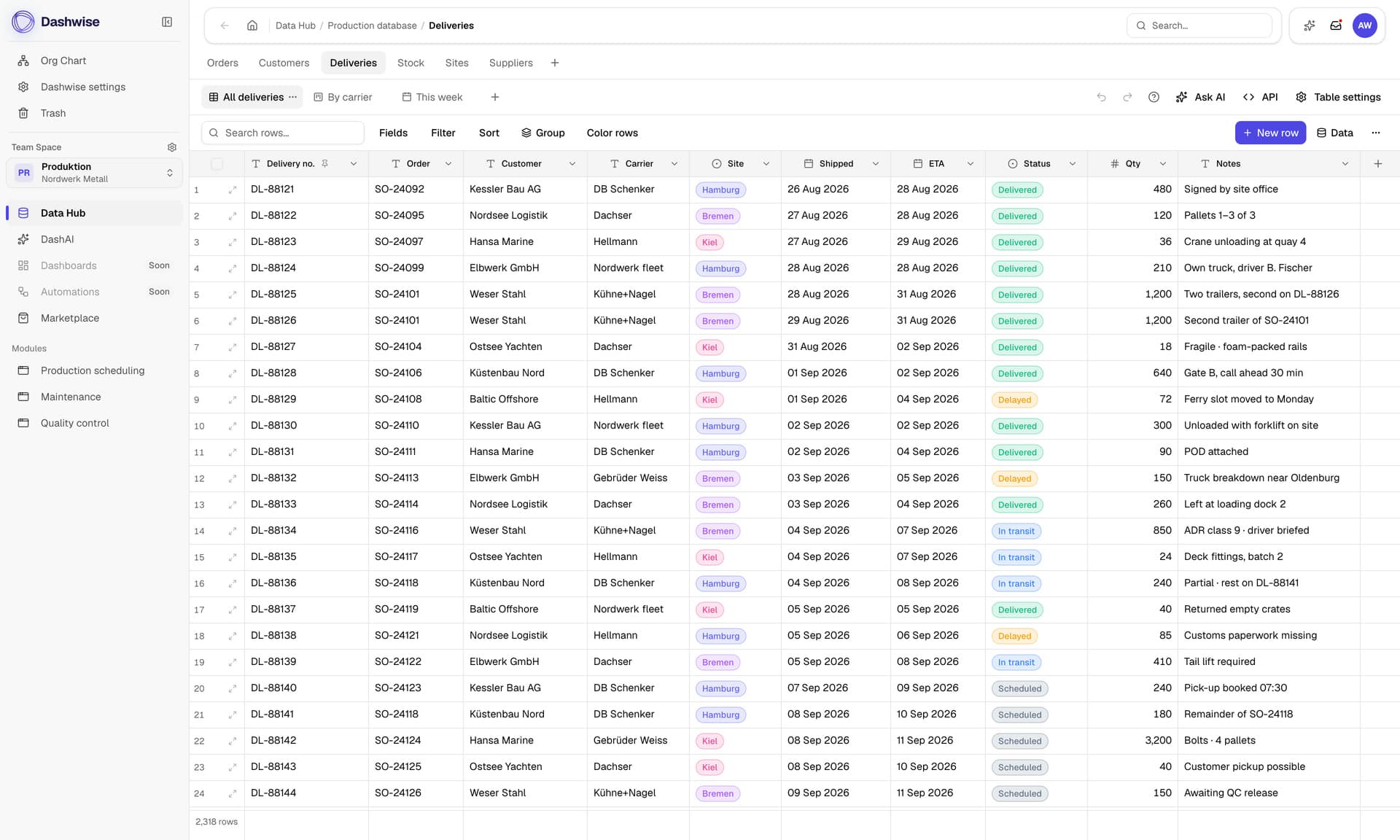
- Typed at the database level
- Fields become real columns. Postgres enforces the constraints.
- Views without copies
- Filters, sorts and saved views sit on one source table.
- BI-ready by default
- Metabase, Power BI or plain SQL connect without an ETL step.
Modules
What are modules?
A module isn't a plugin. It's a full application, from a leave request to your entire production control, and each can be swapped on its own.
Out of the box
- In use the same day
- Installed from the marketplace
- Assign roles, done
- Updates come from us
Tailored
- In days, not weeks
- A standard module as the base
- Fields and flows to match your process
- The configuration is yours
Commissioned
- Ready in weeks
- Your brief, our engineers
- Built in your workspace
- The module is yours
Customer-built
- On your roadmap
- Your developers, the same SDK
- Runs like any marketplace module
- Module and code are yours
Explore the marketplace.
DashAI
Secure AI for endless creativity & efficiency.
DashAI runs in your workspace, on typed Data Hub tables and the permission model every module reads. It never answers past your role.
DashAI Chat
- How many tasks are open today
- What moved in this module this week
- General questions, like any assistant
- Nothing leaves the workspace
DashAI Analytics
- A dashboard for last quarter
- The monthly report, every Monday
- A chart of that one column
- Live tables, never an exported snapshot
DashAI Builder
- A module for an existing process
- A real module out of an Excel file
- The same runtime as the marketplace
- Changes until it fits exactly
Set before anyone asks
Choose your model
Set the provider and the model per workspace, and switch any time.
No data leaves
Your data stays in the workspace, and no model is trained on it.
Scoped per role
Every answer is cut to the role of the person asking.
Admin control
Usage, limits and who may ask at all are workspace settings.
Our vision
Software should adapt to how you work. Not the other way around.
The controls your security review asks about.
Elsewhere security is a consulting project or a paid upgrade. Here it belongs to your workspace, and never to the quote.
- SSO and SCIM
- Sign in through your identity provider. Joiners and leavers follow.
- Granular permissions
- Access needs the grant, the role and the application's rules at once.
- Scoped credentials
- One key per installation, revocable at any time.
- IP restrictions
- Access can be limited to your own IP ranges.
- Audit log
- Every administrative action, across every module, kept ten years.
- EU hosting
- Your data stays in the EU, in a Frankfurt data centre.
- GDPR
- A data processing agreement under Art. 28, plus access, export and deletion on request.
We'll show you the platform. On one of your workflows.
30 minutes on a shared screen: the workspace, the Data Hub under it and one module, set up for a process you run today.
Rather see a number first?See pricing